Posted on

Mortgage affordability calculator: how much could you borrow?

Mortgage affordability calculator: how much could you borrow?

A mortgage affordability calculator can give you a useful starting figure, but it can’t promise that a lender will offer you that amount. If you’re deciding which homes to view and what repayments might fit your budget, treat the result as an estimate, not a decision.

Taylors’ mortgage calculator can help you make an early estimate before you start viewing. This guide explains what the figure can tell you, why a lender’s assessment may differ, and how income, regular spending and existing borrowing can affect what you may be able to borrow. It also covers the difference between a borrowing estimate and a realistic home-buying budget, including the costs of moving.

For buyers in Charnwood, local prices can help put the numbers in context. ONS figures for July 2026 put the average first-time buyer price at £232,000, while average prices were £217,000 for terraced homes and £133,000 for flats or maisonettes. These are broad guide figures, not a measure of what every property costs. Use them as context while setting a grounded search budget for Rothley, nearby villages and across Leicestershire.

Key Takeaways

  • A mortgage affordability calculator gives you an early estimate, not a mortgage offer or guarantee.
  • Income is only part of the picture. Regular commitments, your deposit and household circumstances can all affect affordability.
  • Compare estimated borrowing with the monthly spending limit that feels manageable, leaving room for household costs and a financial buffer.
  • Set a personal ceiling for your Charnwood property search and allow for other purchase and moving costs.
  • Use Taylors’ mortgage calculator as a first step, then treat the result as a guide rather than a lender’s decision.

What does a mortgage affordability calculator actually estimate?

A mortgage affordability calculator gives an indicative estimate of how much you might be able to borrow, based on the details you enter. It can help you plan a property search, but the result is only as useful as the information behind it. It is not a lender’s decision or a promise of the amount you’ll receive.

In brief: a calculator offers an early guide based on your information. A lender makes its own assessment of your circumstances and the property.

The estimate is about potential borrowing, not necessarily a comfortable household budget. A lender may assess whether repayments meet its criteria, but you also need to decide what feels sustainable alongside your everyday spending, plans and need for a financial cushion. Two buyers with similar estimated borrowing limits might choose different property budgets because their priorities and monthly commitments differ.

The term “affordability” can also refer to broader housing measures. A Housing Affordability Index looks at housing costs in relation to income at a wider level, rather than estimating an individual buyer’s mortgage eligibility. A general measure can offer context, but it can’t predict what a particular lender will decide about your application.

What is the difference between affordability and a mortgage agreement?

A calculator provides an early indication. An agreement in principle is a separate step: a lender considers information about you against its requirements and indicates how much it may be prepared to lend. It is not a formal mortgage offer or a guarantee that an application will be accepted. Lenders can assess the same circumstances differently, so one calculator result is not a verdict from the whole market.

Even after an agreement in principle, the lender’s decision may depend on a fuller application and further checks. The property itself can also matter. Keep each stage in perspective: an online estimate helps with initial planning, while the lender decides whether to lend and on what terms.

When should a buyer use an affordability calculator?

Use one early, before choosing a firm property-search range. The estimate can help you prepare questions about how regular commitments are considered or what might change the amount available. It can also help you compare potential borrowing with the monthly cost you would feel comfortable managing.

Revisit the estimate if your circumstances or the information you enter changes. A different income, deposit, household commitment or borrowing balance may affect the result, depending on the calculator and lender. Use accurate figures and treat the output as a planning snapshot, not a fixed ceiling. It is a practical starting point for setting your home-buying budget.

How income, deposit and spending shape a mortgage affordability estimate

A mortgage affordability estimate depends on more than your headline salary or deposit. Income helps indicate what may be affordable, while regular commitments and household costs affect how much room remains in your budget. Your deposit changes how much you need to borrow, but it is only one part of the calculation.

Affordability depends on more than salary or deposit alone: it reflects income, financial commitments, available savings and the needs of your household.

Which financial details can change the estimate?

Income is one factor, but how it is recorded matters. Gross income is your pay before tax and other deductions; take-home pay is what reaches your bank account. A calculator or lender may use income information in a particular way, so follow the tool’s instructions. For your own monthly budget, start with take-home pay, as that is what you have available to spend.

Existing credit commitments, such as loan or credit card repayments, can reduce the amount left for mortgage costs. For your personal budget, include regular household bills, travel, childcare and other recurring expenses rather than relying on a best-case month. Household circumstances can affect both day-to-day costs and how a lender views an application.

Lenders do not all assess applications in the same way. They may weigh income, commitments and household details differently, so there is no universal formula that turns a salary into a guaranteed borrowing figure. The National Association of Realtors Housing Affordability Index offers a broader example of affordability being considered against income and housing costs. It relates to the US market, so it should not be used as a direct guide to a UK lender’s decision.

Why does the deposit matter to your budget?

For a given purchase price, a larger deposit means you need to borrow less. That changes the amount of mortgage you need, but does not guarantee that a lender will approve an application or offer particular terms. Your overall circumstances and the lender’s criteria still matter.

Keep deposit savings separate from the rest of your purchase budget. You may also need funds for buying and moving, so do not treat every pound you have saved as available for the deposit. The right balance is personal: a larger deposit may reduce the amount borrowed, while keeping savings back can leave more room for expenses and unexpected needs.

Make your estimate more useful by entering accurate, up-to-date figures and checking them before you start. Include commitments you might otherwise overlook, and revisit the calculation if your income, borrowing or household costs change. If you are using the result to shape a search in Charnwood, Taylors can offer local property guidance. Discuss your Charnwood property search with Taylors.

Mortgage calculator estimate versus a comfortable buying budget

A mortgage affordability calculator may show potential borrowing, but that is not automatically the right amount to spend on a home. Set a more grounded budget by separating what you might borrow from what you are comfortable paying each month and the total funds you will need to buy and move.

Budget figureWhat it meansHow to use it
Estimated borrowingAn indicative amount you may be able to borrow, subject to a lender’s assessment.Treat it as a starting point, not a target price.
Planned spending limitThe property budget you decide feels manageable for your circumstances.Check expected repayments against your household spending and savings plans.
Total purchase budgetThe funds needed for the home, deposit and costs associated with buying and moving.Keep costs outside the mortgage in your overall plan.

Why might the calculator’s maximum feel too high?

A lender’s assessment and your personal comfort measure different things. Even if an estimated repayment looks affordable on paper, account for regular bills, existing commitments, savings goals and household costs that can vary. There is no single buffer that suits every buyer. Test a lower spending limit against your actual monthly outgoings and consider whether it leaves room for unexpected expenses.

Look beyond the mortgage payment. A home brings ongoing costs, and your usual spending may change after moving, for example if your travel arrangements or household bills are different. Leave room to manage those costs without relying on every month going exactly to plan. A lower personal ceiling can keep your search aligned with the life you want to maintain, not just the maximum a calculator suggests.

What costs sit outside the mortgage estimate?

The borrowing estimate may not show the full amount you need to buy and settle into a property. Include purchase-related costs, removals and other moving expenses, as well as ongoing homeownership costs such as maintenance and household bills. Which costs apply, and how much they are, will depend on your circumstances and the property.

Keep these funds separate from your deposit and monthly repayment plan. If all your savings go towards the deposit, you may have less flexibility for expenses during the move or after you get the keys. Taylors’ guide to the true cost of moving house in Leicestershire can help you consider the broader picture. Use it alongside your own budget rather than assuming every cost applies to every purchase.

Before settling on a search ceiling, compare estimated borrowing with your chosen spending limit and total purchase budget. This can help you focus on homes that fit your finances, while keeping money aside for the practical costs of moving.

Mortgage affordability calculator: how much could you borrow?

A borrowing estimate becomes more useful when you turn it into a clear search plan. Start with the estimate, set a personal ceiling that reflects your household budget, allow for costs beyond the purchase price and refine what you are looking for. This keeps the search practical without letting one calculator result dictate every decision.

  1. Start with an estimate. Use the result from a mortgage affordability calculator as an initial guide, not a target you have to reach.
  2. Choose your own ceiling. Decide what you would be comfortable spending based on your wider circumstances.
  3. Allow for other costs. Keep funds aside for purchase and moving expenses, as well as the costs of running a home.
  4. Refine the search. Match your budget to the property features and locations that matter most to you.

How can buyers set a sensible search ceiling?

Start below the maximum estimate if that better suits your monthly budget or gives you more financial breathing space. Separate essential property needs from features you would like but could compromise on. This makes it easier to compare homes without stretching your budget for something that is not essential. Review your ceiling if your income, deposit or regular commitments change.

Write down the monthly amount you are comfortable committing to, then use it to guide the property budget you explore. A lender’s view of borrowing and your preferred spending limit are different considerations. Keep your own limit in view as you search, particularly when a property tempts you to go beyond it.

How should local searches reflect your budget?

Charnwood offers a range of places to consider, and the homes available will vary over time. Rothley, Quorn, Mountsorrel, Anstey, Sileby, Syston and Barrow upon Soar are useful starting points for a local search, not a set of price comparisons. Focus on homes that match your budget and requirements rather than assuming every property in one village will suit the same buyer.

Describe your search in practical terms: the type of home you need, how many bedrooms would work and any location priorities, such as being close to family or a regular journey. Then compare suitable listings across the areas you are open to. If options are limited, decide whether to widen the location, adjust a preference or wait for a better match. Change one thing at a time so you can see how it affects your choices.

If you are moving from an existing home, factor in the funds available after a sale when setting your budget. The amount depends on the property and the details of the move, so include it in your planning rather than assuming it will match a particular figure.

Discuss your Charnwood property search with Taylors

Using Taylors’ mortgage calculator as a first step towards buying

Taylors’ mortgage calculator can help you begin planning a property search by giving you an estimate to consider alongside your own budget. It is an early planning tool, not a lender’s decision. Use the result to organise your next steps rather than treating it as an amount you need to borrow or spend in full.

With that distinction in mind, you can clarify what matters most in a home, identify the areas you want to explore and keep a realistic spending limit in view. Taylors helps buyers search for residential property across Leicestershire, including Charnwood and nearby villages.

What should you do after getting an estimate?

Review the information and assumptions behind the estimate. If a figure has changed or no longer reflects your circumstances, update your planning. Then consider these next steps:

  • Write down the budget you feel comfortable using for a property search, taking your wider household finances into account.
  • Note questions about eligibility, borrowing or mortgage products to discuss with an appropriately qualified mortgage professional.
  • Use your chosen budget to guide the homes and locations you explore, rather than treating the estimate as a spending target.

A mortgage professional can discuss your circumstances, lender criteria and suitable mortgage products. This is separate from estate agency guidance. Mortgage questions belong with a suitably qualified professional, while you can discuss property-search questions with a local estate agent.

How can local property guidance support your next step?

Once you have a comfortable budget and a clearer idea of your requirements, local guidance can help bring your search into focus. Taylors can help you explore residential properties across Leicestershire, including Charnwood and surrounding villages. Discuss the type of home you are looking for, preferred locations and essential priorities, so your search is based on what suits you rather than an estimate alone.

If your requirements shift as you view properties, take stock of what you have learnt and refine your search. Perhaps a different layout matters more than an extra room, or you are open to another village. Keep any change in spending within the limit you have set for yourself.

The estimate is a place to begin. Pair it with a considered budget and local property knowledge for a more grounded basis for exploring homes in Leicestershire.

Talk to Taylors about your Leicestershire property search

Take your next step with a clear plan

Your next move does not need to be a firm commitment to buy. Use the mortgage affordability calculator as one planning reference, then keep a short list of questions and property priorities as your search develops. You will have something practical to revisit if your circumstances change or you learn more about the homes available.

For mortgage eligibility and product recommendations, speak with an appropriately qualified mortgage professional. For local property-search guidance, Taylors is an independent Rothley estate agency established in 1992, helping buyers explore residential property across Leicestershire. Keeping those roles clear can make the next stage more straightforward.

Talk to Taylors about your Leicestershire property search

Take the process at a pace that suits you. With a considered plan and local guidance, you can move towards a home that fits your priorities and budget.

Frequently Asked Questions

How accurate is a mortgage affordability calculator?

Its usefulness depends on the figures entered and the assumptions built into the tool. Two calculators may produce different results because they ask for different information or process it differently. Check the instructions, use current figures from your records and note when you last updated them. If a result changes unexpectedly, review the inputs before drawing conclusions.

Can a mortgage affordability calculator guarantee I will be approved?

No. Only a lender can decide whether to approve a mortgage application. During the application process, the lender may review supporting documents and assess the property as well as your financial circumstances. If you are preparing to apply, organise relevant information and discuss eligibility with an appropriately qualified mortgage professional. This can help you understand what the online result leaves unanswered.

How much deposit do I need to use a mortgage affordability calculator?

There is no one deposit amount that applies to every calculator. Check what the tool asks for and, if it requires a figure, enter the amount you realistically expect to have available for the purchase. Do not include savings you intend to keep for other needs. If you are still building your deposit, revisit the calculation as your savings change.

Does a mortgage affordability calculator include bills and moving costs?

That depends on the calculator, so check which costs it asks you to enter and what its result represents. For your own planning, make a separate checklist of costs that may apply to your move, then add ongoing household expenses to your monthly budget. Replace rough assumptions with actual figures when you have them. This helps prevent an online estimate being mistaken for a complete purchase budget.

Can I use a mortgage affordability calculator if I am self-employed?

Yes, but a basic online result may not capture the detail of self-employed income, particularly if earnings vary. Before speaking with a mortgage professional, organise a clear record of how your income has changed over time and note any unusual fluctuations. They can explain how a lender may assess your circumstances and what supporting information could be relevant to an application.

Should I use a mortgage affordability calculator before viewing homes?

Yes. It can give you a starting point for deciding which properties to shortlist. Before booking a viewing, note the features each home offers and any questions you want to ask. Afterwards, compare what you saw with your priorities and refine your shortlist. This keeps the search focused on homes that suit your needs, not just their advertised features.


Sam Cable - Branch Manager

Article by

Sam Cable – Branch Manager

Posted on

The True Cost of Moving House in Leicestershire: A 2026 Resource Guide

The True Cost of Moving House in Leicestershire: A 2026 Resource Guide

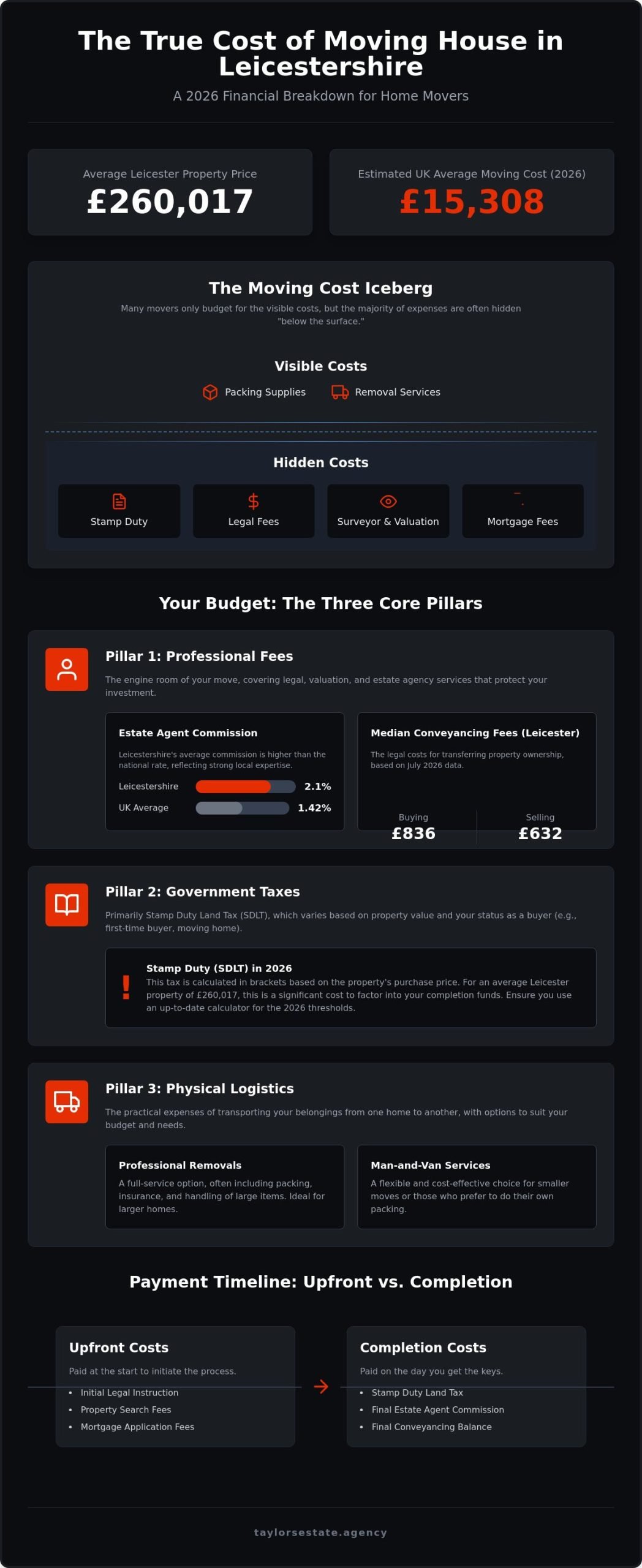
Did you know the average UK move in 2026 now costs upwards of £15,300 when every hidden variable is accounted for? Whilst national averages offer a starting point, the true cost of moving house in Leicestershire is a distinct calculation shaped by our local property market and regional professional rates. It’s understandable to feel a sense of trepidation as completion approaches, especially when you’re worried about unexpected fees or shifting tax thresholds surfacing at the final hour.

We believe that moving should be defined by the excitement of a new chapter rather than the stress of financial uncertainty. This guide provides a clear, line-item breakdown of the expenses you’ll face, from current Stamp Duty Land Tax rates to the median cost of local removal services. By the time you’ve finished reading, you’ll have a realistic budget and the confidence to manage your move without any unwelcome surprises. We’ve mapped out the path so you can focus on settling into your new home with total peace of mind.

Key Takeaways

  • Identify the “moving cost iceberg” by distinguishing between visible logistics and the hidden fees that often surface during the final stages of a move.
  • Navigate the 2026 Stamp Duty Land Tax thresholds with confidence, ensuring your property purchase aligns with the latest government regulations.
  • Evaluate professional service fees by understanding local commission structures and the long-term value of choosing regional experts over national call centres.
  • Calculate the physical cost of moving house leicestershire by comparing professional removal packages against flexible man-and-van services tailored to your home’s size.
  • Learn how to build a resilient financial plan using a mortgage calculator and a strategic contingency fund to protect against unexpected completion costs.

Understanding the Total Cost of Moving House in Leicestershire

Moving home is often described as one of life’s most significant transitions. Much of the stress of moving stems from what we call the “Moving Cost Iceberg.” Above the surface, you see the obvious logistical expenses like hiring a removal van or buying packing crates. However, a vast portion of the financial weight lies beneath the water line. These hidden costs, such as legal disbursements, search fees, and government taxes, can quickly overwhelm an unprepared budget. In 2026, the estimated national average for these combined expenses is approximately £15,308 for a mid-sized property. Given that average property prices in Leicester currently sit around £260,017, the cost of moving house leicestershire families must prepare for is a substantial figure that demands a proactive approach.

Budgeting early is not just about financial discipline; it is a vital safeguard against “chain collapse.” When a buyer or seller discovers a shortfall in their funds during the final weeks of a transaction, it can cause the entire sequence of sales to stall or fail. To maintain a steady hand throughout your journey, it helps to categorise your budget into three distinct pillars:

  • Professional Fees: Costs associated with estate agency services, legal instruction, and surveyors.
  • Government Taxes: Primarily Stamp Duty Land Tax (SDLT), which varies based on property value and your buyer status.
  • Physical Logistics: The practical expenses of transporting your life from one postcode to another.

Upfront vs. Completion Costs: What to Pay and When

Timing is everything when you are managing a move. Some expenses are required immediately to get the process moving. For instance, you’ll likely need to pay for initial legal instruction and search fees at the start. We recommend starting with Free Property Valuations to establish a realistic sale price, which then allows you to use a Mortgage Calculator to understand your true purchasing power. Whilst many local agents offer “No Sale, No Fee” structures, which protect you if a deal falls through, other costs like Stamp Duty and final professional commissions are typically settled upon completion. Understanding this timeline ensures you have the right liquidity at the right moment.

Why Local Market Dynamics Impact Your Budget

The cost of moving house leicestershire residents experience is often influenced by specific regional demand. In sought-after Charnwood villages like Rothley and Quorn, the high volume of transactions can impact the availability of local solicitors and surveyors, potentially affecting the quotes you receive. We often see a “Leicestershire Premium” in 2026, which is defined as the increased logistical and professional costs associated with high-demand village locations where limited specialist availability meets a competitive buyer market. Choosing a partner with deep-rooted knowledge of these local quirks can help you navigate these regional price variations with total confidence.

Professional Fees: Conveyancing, Valuations, and Estate Agency

The professional fees you encounter during a move are the engine room of the entire transaction. They ensure your sale is legal, your investment is sound, and your interests are protected. In Leicestershire, estate agent commissions typically average around 2.1% of the final sale price, which is notably higher than the UK national average of 1.42%. These fees generally range from 1.5% to 2% plus VAT, depending on the level of service and marketing reach required. Whilst online fixed-fee models exist, many local sellers find that the proactive negotiation and “steady hand” of a traditional local agent often result in a higher final sale price that more than covers the commission difference.

For individuals also managing commercial interests or corporate relocations, seeking dedicated legal advice is paramount; firms like Matthew Fornaro, P.A. offer the specialised business law expertise required to handle complex legal transitions alongside a residential move.

Before you commit to a purchase or set a firm moving budget, obtaining an independent valuation is a vital first step. This provides a realistic foundation for your financial planning, allowing you to use a mortgage calculator with accurate figures. To get started, you can book one of our Free Property Valuations to establish your current home’s market position.

Choosing a Solicitor for a Leicestershire Property Sale

Conveyancing is a significant component of the cost of moving house leicestershire families must account for. Data from July 2026 shows that the median legal fee for buying a house in Leicester is £836, whilst selling a house averages £632. You should also budget approximately £363 for disbursements, which cover essential costs like local authority searches. Whilst “cheap” national call centres might offer lower headline rates, they often lack the local knowledge required to navigate specific Leicestershire Land Registry quirks. A local solicitor understands regional boundaries and historical nuances, which frequently prevents the delays that lead to chain collapse. For more guidance on selecting the right professional, see our resource on Selling Your Property: A Guide to Choosing the Best Estate Agents in Leicestershire. Your solicitor will also ensure the correct calculation and submission of your Stamp Duty Land Tax (SDLT) return upon completion.

Valuation and Surveying: Protecting Your Investment

It’s vital to distinguish between a mortgage valuation and a structural survey. A mortgage valuation is conducted for the lender’s benefit to confirm the property is worth the loan amount. To protect yourself, a RICS Level 2 (HomeSurvey) or Level 3 (Building Survey) is essential. In the East Midlands, these surveys typically range from £400 to over £1,000 based on the property’s size and age. If you are beginning your journey in a specific area, you might find our guide on How Much is My House Worth in Rothley? A 2026 Homeowner’s Guide helpful for understanding local market dynamics. Homeowners in nearby LE7 postcodes may also benefit from reading our detailed analysis of how much is my house worth in Syston, which explores the gap between recent sold prices and current asking price trends.

Calculating Stamp Duty and Government Taxes in 2026

When calculating the total cost of moving house leicestershire residents often find that government taxes represent the single largest lump-sum payment. It is a common objection that Stamp Duty Land Tax (SDLT) makes moving home feel unaffordable, yet this perspective often stems from a lack of clarity regarding current thresholds. Whilst the prospect of a five-figure tax bill can feel daunting, understanding the specific bands allows you to plan your liquidity well in advance of completion day. These funds must be liquid and ready for your solicitor to transfer to HMRC, as they cannot typically be added to your mortgage loan.

For most buyers, the standard residential rates apply, but 2026 regulations continue to offer significant relief for those entering the market for the first time. First-time buyers pay 0% on properties up to £300,000, which covers a substantial portion of the terraced and semi-detached housing stock in Leicester. If you are purchasing an additional property, such as a buy-to-let investment or a second home, an additional 5% surcharge is payable on top of the standard rates. You should consult the Official Stamp Duty Land Tax rates for the most precise calculations based on your specific circumstances.

2026 Stamp Duty Thresholds for Leicestershire Buyers

To help you visualise the impact on your budget, consider the following comparison for standard residential purchases in 2026:

  • Property Price £125,000: £0 Tax Owed
  • Property Price £250,000: £2,500 Tax Owed
  • Property Price £400,000: £10,000 Tax Owed
  • Property Price £600,000: £20,000 Tax Owed

For example, if you are moving into a £350,000 family home in Sileby, your total SDLT bill would be £7,500. This is calculated by paying 0% on the first £125,000, 2% on the next £125,000, and 5% on the final £100,000. Having this clear figure early in your journey prevents the anxiety that often occurs when “hidden” costs surface during the final weeks of legal work.

Land Registry and Local Authority Search Fees

Beyond Stamp Duty, your solicitor will conduct “searches” to protect your investment. These costs vary depending on which local council governs your new home. A purchase in Charnwood may have slightly different search turnaround times and costs compared to Hinckley & Bosworth. Typical disbursements include environmental, drainage, and chancel searches, which ensure there are no underlying liabilities attached to the land. You should also budget for Land Registry registration fees, which are tiered based on the property value. Whilst these individual fees are smaller than Stamp Duty, they are essential components of the cost of moving house leicestershire families must factor into their final completion statement.

The True Cost of Moving House in Leicestershire: A 2026 Resource Guide

Removals and Logistics: The Cost of the Physical Move

Whilst taxes and legal fees are settled on paper, the physical relocation is where the cost of moving house leicestershire becomes most tangible. Professional removal quotes are generally calculated based on the volume of belongings, the distance between postcodes, and the complexity of the access at both ends. For a three-bedroom house in Leicester, current 2026 data suggests you should budget approximately £939 for a professional team, though smaller one-bedroom moves can average around £485. These figures provide a helpful baseline, but your specific requirements will dictate the final investment.

Strategic timing can lead to significant savings. Booking your move for a Tuesday or Wednesday can often reduce your removal fees by up to 20% compared to a Friday or weekend. Most firms experience peak demand at the end of the week to align with bank holidays or typical completion patterns, so choosing a mid-week slot is a simple way to protect your budget. Before you commit to a specific moving date, it’s wise to use a Mortgage Calculator to ensure your overall financial plan remains robust throughout the transition.

You must also decide between a “Man and Van” service and a full-service removal company. For smaller moves or student relocations, a man and van at roughly £55 per hour for two men is a cost-effective choice. However, for larger family homes, a full-service company provides the packing materials, structured insurance, and the heavy lifting expertise that prevents physical exhaustion and logistical delays.

Local Logistical Challenges in Leicestershire Villages

Historic centres like Rothley and Quorn present unique challenges that can impact your final quote. Narrow lanes and strict parking restrictions often require removal firms to use smaller shuttle vehicles or additional staff for “long carry” distances where the van cannot park directly outside the property. If you are moving into a modern apartment block in the city centre without lift access, expect labour costs to rise accordingly. Hiring a local firm that knows the geography of Charnwood ensures these factors are accounted for upfront, preventing surprise surcharges on the day. Families considering a relocation to the western edge of the county may also wish to explore our comprehensive guide to living in Ashby-de-la-Zouch, Leicestershire, which covers property trends, transport links, and the town’s thriving community.

Insurance and Special Item Handling

Standard home insurance rarely covers your belongings whilst they are in the back of a moving van. Most professional firms include “Goods in Transit” insurance, but you should verify the coverage limit, especially if you possess fine art or antiques. Specialised items like pianos or heavy garden machinery often incur additional fees due to the specialist equipment and extra manpower required for safe transport. DIY removals often result in higher long-term costs due to breakages and the lack of professional-grade packing materials.

Strategic Budgeting: Planning Your Move for Success

The final stage of managing the cost of moving house leicestershire involves shifting from immediate expenses to long-term financial stability. It’s easy to get lost in the major fees, but strategic budgeting ensures you don’t just reach the finish line, but cross it with your finances intact. We recommend establishing a “Contingency Fund” equal to 10% of your total estimated moving costs. This provides a vital buffer for those minor, unexpected requirements that often arise during the final transition, such as last-minute repairs, professional cleaning services, or essential administrative fees.

Choosing an independent agent like Taylors often provides a superior return on investment compared to national alternatives. Whilst a discount firm might offer a lower headline fee, our personalised negotiation strategies aim to secure the best possible market price for your home. This difference in the final sale price frequently outweighs the initial commission cost, leaving you with more equity to put toward your new property. This proactive strategy is the most effective way to manage the total cost of moving house leicestershire families encounter, ensuring you remain in control from the first valuation to the final box.

Don’t forget the final checklist of smaller, logistical costs that can accumulate if left unplanned:

  • Mail Redirection: Royal Mail services to protect your identity and ensure you don’t miss vital correspondence.
  • Utility Settlements: Final bill payments and potential connection fees for your new postcode.
  • Professional Cleaning: Many contracts require a professional end-of-tenancy or pre-move clean to be documented.
  • Media Transfers: Broadband and digital media installation charges that may apply when moving your services.

The Role of Professional Financial Planning

Our integrated Mortgage Calculator is a powerful tool designed to help you see the “real” monthly cost of your move post-completion. It’s not just about the purchase price; it’s about balancing the equity from your current sale with the ongoing costs of your new mortgage. We encourage our clients to begin organising their finances at least six months before listing their property. This timeline allows you to clear any minor debts, gather necessary documentation, and approach the market with a clear understanding of your true purchasing power.

Why a “Steady Hand” Matters in 2026

The 2026 property market requires a transparent and methodical approach to avoid costly delays. With over 30 years of local experience, Taylors Estate Agency provides the “steady hand” needed to navigate complex chains and regional market shifts. We pride ourselves on clear communication, ensuring you are never surprised by hidden fees or sudden changes in the process. Our goal is to reduce your anxiety by providing a structured, reliable path to your new home. Contact Taylors for a free, professional valuation and moving cost consultation.

Taking Your Next Step with Confidence

Navigating the cost of moving house leicestershire requires more than just a calculator; it demands a clear understanding of the local market and a proactive approach to budgeting. By identifying the hidden fees beneath the surface of the “moving iceberg” and accounting for the specific 2026 Stamp Duty thresholds early, you’ve already taken the most important step toward a stress-free transition. Whilst national averages provide a baseline, the specific nuances of our regional villages and professional rates will ultimately shape your journey.

At Taylors, we’ve been helping families move across the county since 1992. As an independent agency with deep local roots, we pride ourselves on providing the personalised, transparent service you need to avoid costly delays. Our expertise across residential and commercial property ensures your move is handled with a steady hand and expert care. Book your free Leicestershire property valuation with Taylors today to gain a clear, professional perspective on your home’s worth. We’re here to guide you through every stage of the process. Your new chapter in Leicestershire starts with a solid, reliable plan.

Frequently Asked Questions

How much are estate agent fees in Leicestershire on average?

Estate agent fees in Leicestershire are typically calculated as a percentage of the final sale price plus VAT. Whilst rates vary amongst different agencies, these fees generally cover professional marketing, property portal listings, and the expert negotiation required to secure the best possible price. It is common for local agents to offer a “no sale, no fee” structure, ensuring their interests are aligned with yours throughout the transaction.

Do I have to pay Stamp Duty if I am a first-time buyer in 2026?

First-time buyers in 2026 benefit from significant relief, paying 0% Stamp Duty on properties priced up to £300,000. For homes costing between £300,001 and £500,000, you will pay a 5% rate on that specific portion of the purchase price. However, if the property value exceeds £500,000, the standard residential rates apply to the entire amount, making it essential to calculate your liability early in the process.

What is the cheapest day of the week to move house in Leicester?

Mid-week days, specifically Tuesday and Wednesday, are generally the cheapest times to move house in Leicester. Most removal firms experience their highest demand on Fridays and bank holiday weekends, which often leads to premium pricing and limited availability. By opting for a mid-week relocation, you can often secure more competitive quotes and a more relaxed service from your chosen logistics team.

Can I include my moving costs in my mortgage?

Most moving expenses, including Stamp Duty, legal fees, and removal costs, must be paid as liquid cash and cannot be added to your mortgage loan. Lenders expect you to have these funds set aside separately from your property deposit. Using a mortgage calculator early in your journey will help you understand your total cost of moving house leicestershire and ensure you have a sufficient financial buffer for completion day.

How much should I budget for a RICS HomeSurvey in Charnwood?

The investment for a RICS HomeSurvey in Charnwood varies based on the size of the property and the level of detail you require. A Level 2 survey is typically appropriate for modern homes in reasonable condition, whilst a Level 3 building survey is recommended for older or extended properties. These surveys provide a steady hand during negotiations by identifying structural concerns before you are legally committed to the purchase.

Are there hidden costs when moving to a rural Leicestershire village?

Rural moves often involve unique logistical expenses, such as “long carry” surcharges if a removal van cannot park close to a cottage in a narrow lane. You may also encounter specific professional fees for septic tank inspections or chancel repair searches that aren’t usually required for city-centre homes. These regional factors can influence the overall cost of moving house leicestershire families face when relocating to historic village centres.

What happens to my moving fees if the house sale falls through?

If a sale falls through, your financial liability depends on the specific agreements you have signed with your service providers. Whilst many estate agents operate on a “no sale, no fee” basis, you may still be responsible for legal disbursements and any work already completed by your solicitor. Survey fees and local authority search costs are generally non-refundable as these services are performed in the early stages of the transaction.

How much does professional packing service cost in Leicestershire?

Professional packing services are typically offered as an optional add-on to your standard removal quote. The price is determined by the volume of your belongings and the number of crates required to secure your items safely. Opting for this service often includes the cost of all packing materials and ensures that your possessions are covered by the removal firm’s “goods in transit” insurance policy during the move.

Sam Cable - Branch Manager

Article by

Sam Cable – Branch Manager